Blog, New Posts

Shenzhen Metro Guide | Metro Map, Card & Route Tips

Shenzhen Metro Guide Metro Map, Card & Route Tips

If you are planning a first Shenzhen trip, the Shenzhen Metro is the fastest way to keep the city from feeling too big. Shenzhen’s official transport guide says the network has 16 lines in service, and the airport guide shows that Metro Line 11 connects directly into the airport complex through the GTC concourse. That makes a short trip much easier to manage, especially when you are trying to fit sightseeing, food, and hotel check-in into the same day.For planning, start with Travel Resources before you build your route. For an easier day, choose Airport Transfer when your arrival time is awkward, and book a Taxi when you need a low-friction late-night move.

A lot of people treat transport as an afterthought. In Shenzhen, that is a mistake. A good Shenzhen Metro plan saves time, cuts stress, and makes it easier to choose a Shenzhen hotel near a metro station instead of guessing where to stay.

Why Shenzhen Metro matters for your trip

The city’s metro network is not just a commuter tool. It is the backbone of a practical city trip. The official metro page lists major visitor-friendly lines such as Shenzhen metro line 1, Shenzhen metro line 3, Shenzhen metro line 5, Shenzhen metro line 9, Shenzhen metro line 11, Shenzhen metro line 13, and Shenzhen metro line 16, while the broader network now has 16 lines in service. That means your route can be built around real districts instead of random guesses.

For travelers, that matters because Shenzhen is spread out. A smart Shenzhen map with metro stations lets you decide whether your day is downtown, border-side, airport-side, or coast-side. The metro is also the easiest way to keep a Shenzhen trip from turning into a taxi-only budget drain.

How to read the Shenzhen metro map

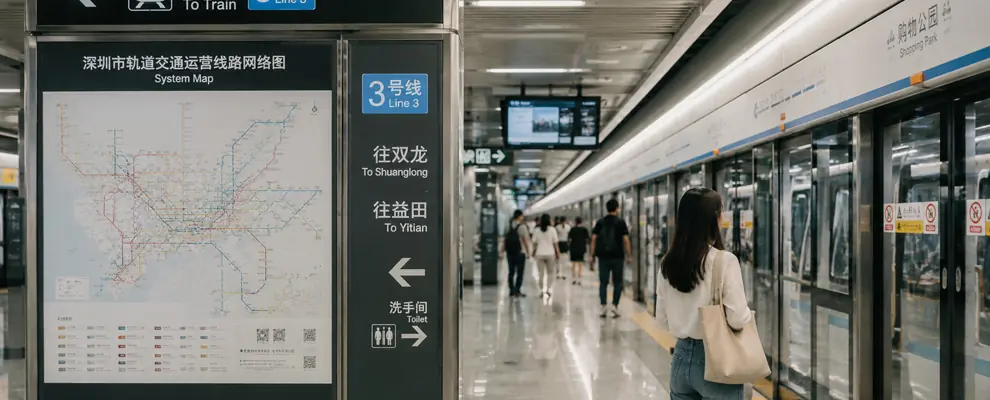
A live Shenzhen metro map app is better than a static screenshot. The metro authority says riders should refer to the daily schedule, the official website, or the official WeChat public account 深圳地铁 because service details can change. If you are using a Shenzhen metro app, treat it as a live tool, not a one-time download.

The lines that matter most for visitors

Here is the short version of the map logic:

LineWhat it is useful forOfficial example stops
Shenzhen metro line 1Downtown, border-side access, shoppingLuohu, Guomao, Laojie (Shenzhen Government Online)
Shenzhen metro line 3Core city center and business districtsFutian Bonded Area, Shopping Park, Futian, Children’s Palace, Lianhuacun (Shenzhen Government Online)
Shenzhen metro line 5Qianhai and western city movementChiwan, Liwan, Qianwan Park, Qianwan, Guiwan, Qianhaiwan (Shenzhen Government Online)
Shenzhen metro line 9Nanshan and west-side city travelQianwan, Nanyou West, Nanyou, Nanshan Book Mall (Shenzhen Government Online)
Shenzhen metro line 11Airport expressAirport Station, North Airport Station, Futian-bound service (Shenzhen Qianhai Authority)
Shenzhen metro line 13Shenzhen Bay Checkpoint and west-side routesShenzhen Bay Checkpoint, Talent Park, Houhai, Keyuan (Shenzhen Government Online)
Shenzhen metro line 16Eastern districts and tech-side routesTianxin, Technology University, Yanzihu, Shabo, Dongjiang Column Memorial Hall (Shenzhen Government Online)

The other lines on the live map, including Shenzhen metro line 2, Shenzhen metro line 4, Shenzhen metro line 7, Shenzhen metro line 8, Shenzhen metro line 10, Shenzhen metro line 12, and Shenzhen metro line 14, are still part of the network and worth checking in the app before you leave your hotel. The reason is simple: a live map with stations is more useful than memorizing numbers.

What this means in practice

If your hotel is near Futian, lines 3 and 11 matter a lot. If you are crossing toward Shenzhen Bay, line 13 is useful. If you are landing at the airport, line 11 is the first line to check. That is why a Shenzhen hotel near a metro station is usually the smartest choice for a short stay.

Shenzhen Metro cost and Metro pass basics

The city’s official fare rule is straightforward. Ordinary metro rides start at 2 RMB for the first 4 km. The next band is 4–12 km at 1 RMB per 4 km, then 12–24 km at 1 RMB per 6 km, and anything beyond 24 km at 1 RMB per 8 km. If you use a Shenzhen Tong card on ordinary-carriage rides, the city says you get a 5% discount. That is the practical meaning of the Shenzhen Metro cost and the Shenzhen Metro price for most visitors.

For many travelers, the simplest Shenzhen Metro pass is not a complicated tourist pass. It is the Shenzhen Tong card, because the discount is clear and the city already supports it in the fare policy. If your rides are short and frequent, that 5% starts to matter more than it sounds.

A quick cost example

A short ride under 4 km costs 2 RMB. A medium ride between 4 km and 12 km grows gradually, so the metro stays predictable instead of turning into a surprise expense. That predictability is one reason the metro works so well for a Shenzhen city tour or a Shenzhen 3-day itinerary.

Shenzhen airport metro and airport transfer choices

When you land, the cleanest Shenzhen airport metro choice is Metro Line 11 (Airport Express). The airport guide says the entrance to Line 11 is in the GTC concourse, and the first train from the airport toward Futian is 06:04, with the last at 00:01. Toward Bitou, the first train is 06:41, with the last at 00:05.

The same airport guide also shows why the airport is easy to move out of: taxi stands are on the east platform of the GTC, ride-hailing pickup is on the south side, and public buses, coaches, and inter-city buses also operate from the ground transport center. That is useful when you need to compare the metro with a transfer service or a late-night taxi.

For a late landing, or when you are carrying luggage and do not want to think too much, Choose Airport Transfer is often the better call. For a late-night return after dinner, Book a Taxi is the easy backup.

Which app or tool should you use?

Here is the most practical comparison if you are trying to keep a Shenzhen trip organized while you move around the metro network:

ToolWhat it helps withReal-user data
NavanKeeps travel and expense details in one placeG2 shows 4.7/5 from 9,096 reviews; users praise ease of use and streamlined booking. (G2)
TripCreatorBuilds clean itineraries and travel plansCapterra shows 4.5/5 from 10 reviews; users say it is quick for building itineraries. (Capterra)
Shenzhen Metro app / Shenzhen Metro WeChatLive metro schedule and route checkingThe metro authority says to check the daily schedule, official website, or WeChat account 深圳地铁 for current details. (Shenzhen Qianhai Authority)

A simple rule works well here. Use the Shenzhen Metro app or a live Shenzhen Metro map app for daily movement, and use an itinerary tool only when you want the whole trip organized in one place. That is especially helpful if you are planning a Shenzhen trip with multiple districts, hotel moves, or airport timing.

Route tips that fit real travel styles

If you are staying for a short city break, the most useful lines are usually line 3, line 11, line 13, and line 9. If you want downtown shopping and the old core, line 1 matters more. If you are doing a west-side or Qianhai-based trip, line 5 is one of the strongest lines to know. If your plan leans toward the tech side or eastern districts, line 16 becomes more relevant. That is why the Shenzhen Metro is less about memorizing everything and more about choosing the right branch for your day.

A practical example helps. If your day starts near Futian and ends near Shenzhen Bay, the live map can show you whether line 3, line 9, or line 13 keeps the trip cleanest. If your day starts at the airport, line 11 should be your first move. That is the difference between a stressful route and a relaxed one.

Where to stay and how to keep the trip simple

A Shenzhen hotel near a metro station usually saves more time than a cheaper room far from the network. You do not need the fanciest area. You need a hotel that makes the metro easy to reach, because that lowers friction every morning and every night. Once your base is right, the whole trip feels easier.

It also helps to use the metro as your default and save taxis for the awkward gaps. Station-area convenience stops like Metro Supermarket Shenzhen or Shenzhen Metro Vanke can be useful markers for snacks, water, or quick errands before a longer ride, but they should sit below the route choice, not above it. The route comes first.

Conclusion

The easiest way to use the Shenzhen Metro is to stop thinking like a commuter and start thinking like a route planner. The network has 16 lines, the airport is directly connected through Line 11, and the fare structure is simple enough that you can keep costs predictable. A live Shenzhen metro map app, a sensible Shenzhen metro pass, and a hotel near the metro are usually enough to make the city feel much smaller. For the rest of the trip, Start with Travel Resources, then decide whether your arrival is easier with Choose Airport Transfer or a simple Book a Taxi. That combination usually makes a short Shenzhen stay far smoother than guessing as you go.